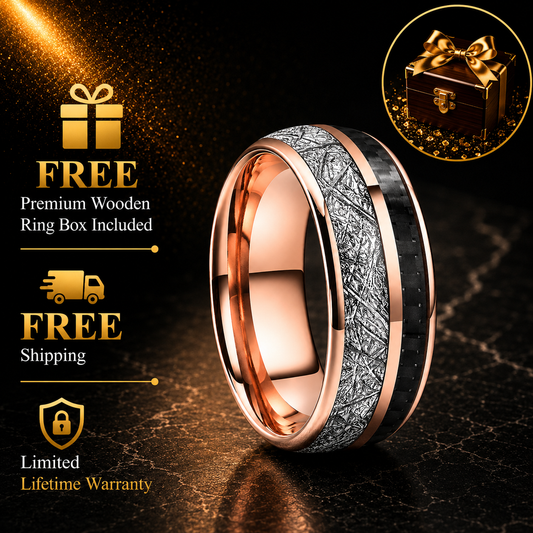
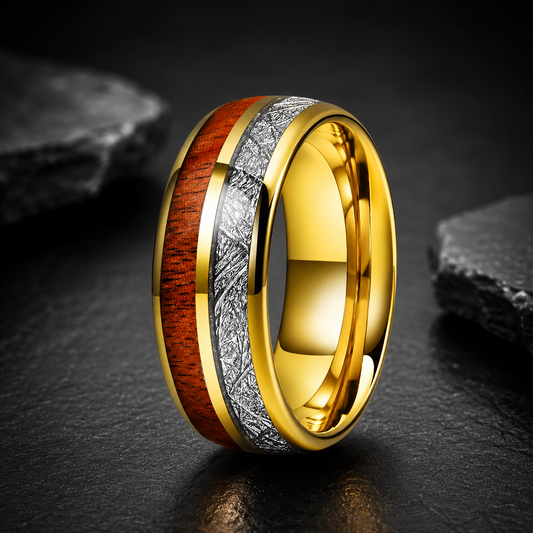
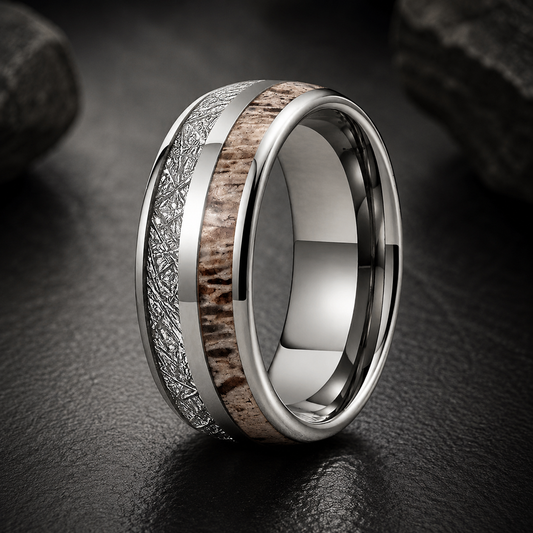
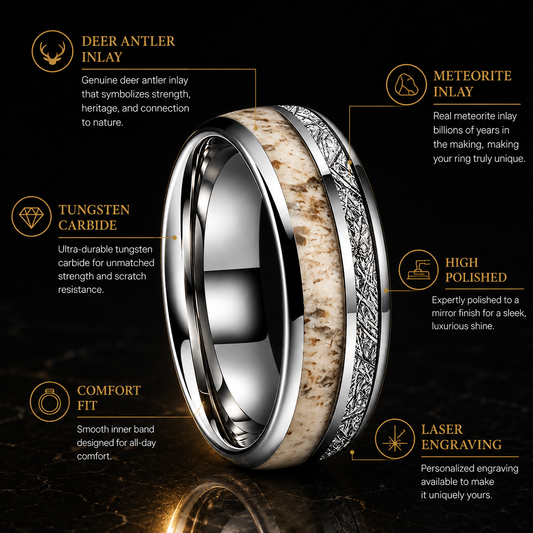
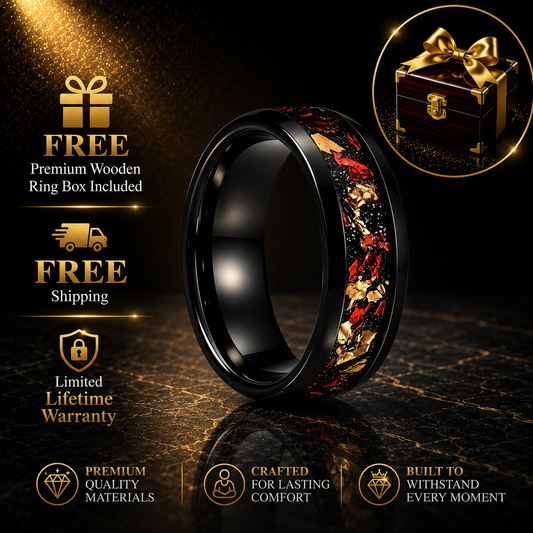
Before the Earth existed, there was the meteorite.
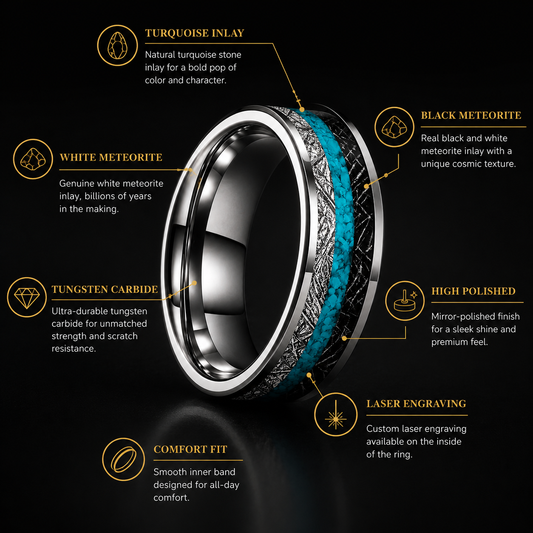
Formed in the early solar system over four billion years ago — before our planet, before life, before recorded history of any kind — Gibeon meteorite traveled through space for an incomprehensible span of time before falling to Earth in what is now Namibia. Each piece carries a crystalline pattern called the Widmanstätten structure: a lattice of interlocking crystals formed over millions of years of cooling in the vacuum of space. It cannot be replicated in a laboratory. It cannot be manufactured. It exists only in material that has made that journey.
That material is now on your finger.
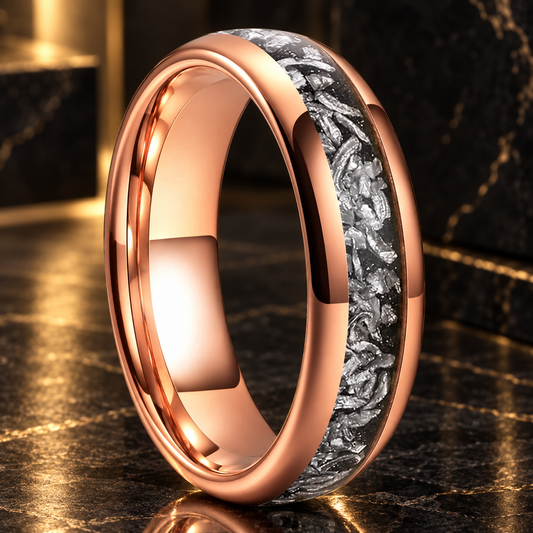
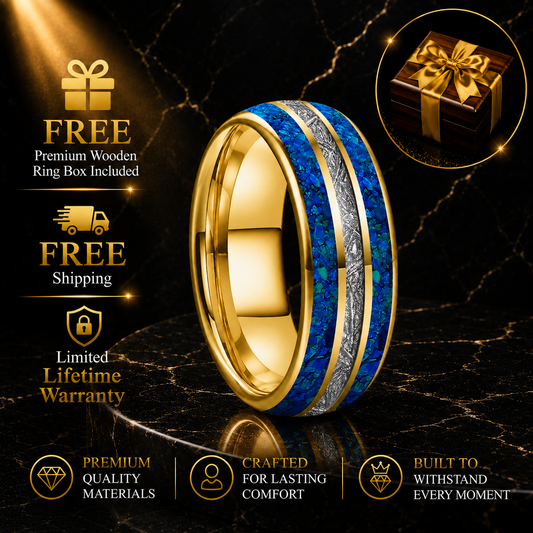
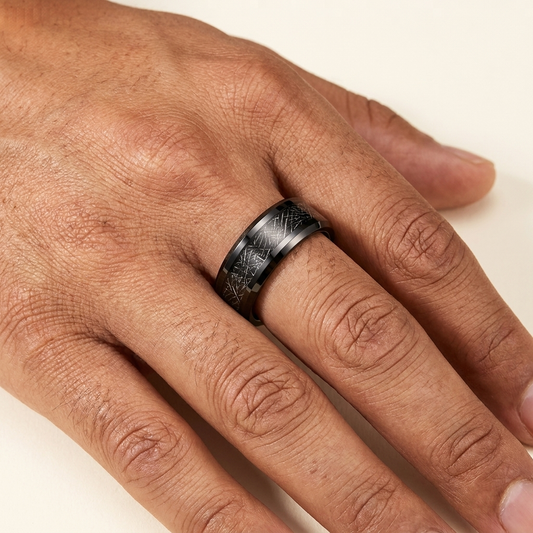
The meteorite ring is the most extraordinary piece in our collection — and possibly the most extraordinary ring a man can wear. Not because of what it looks like, though it looks unlike anything else in jewelry. Because of what it is. A piece of the solar system, billions of years old, set into a tungsten carbide band built for a lifetime of daily wear. History on a scale no other ring can claim.
What Is Gibeon Meteorite?
Not all meteorites are created equal. Gibeon meteorite is an iron-nickel meteorite — one of the most structurally stable and visually striking types of space rock available for use in jewelry. It was first discovered in Namibia in the 19th century, though the fall itself occurred in prehistoric times. Scientists estimate the Gibeon meteorite formed approximately 4 billion years ago as part of the core of a protoplanet that was destroyed in the early solar system.
What makes Gibeon meteorite immediately recognizable is the Widmanstätten pattern — a geometric lattice of interlocking nickel-iron crystals that forms only when iron cools at an extraordinarily slow rate over millions of years in the near-zero gravity of space. The rate of cooling required to produce this pattern is approximately 1 degree Celsius per million years. There is no process on Earth that can replicate it. Every piece of Gibeon meteorite you will ever see carries a pattern that is both scientifically unique and completely unrepeatable.
On a ring, that pattern is revealed through acid etching — a process that brings the Widmanstätten structure to the surface, making it visible and tactile. The result is a surface unlike anything else in men's jewelry: geometric, ancient, and completely one of a kind.
Why Meteorite and Tungsten Belong Together
Gibeon meteorite is extraordinary. It is not, by itself, the most durable material for everyday jewelry wear. Iron-nickel alloys are susceptible to oxidation over time — left unprotected and exposed to moisture, meteorite will gradually develop surface rust. For a ring worn every single day, that's a problem that needs solving.
Tungsten carbide solves it completely.
By setting the meteorite inlay within a tungsten carbide band, the meteorite is protected on both sides by one of the hardest materials on earth — ranked between 8.5 and 9.5 on the Mohs hardness scale. The tungsten framework shields the meteorite from the direct contact and moisture exposure that would cause oxidation, while the meteorite inlay is treated and sealed during the manufacturing process to further protect its surface.
The result is a meteorite tungsten ring that can be worn every day, through real life, without the careful maintenance that a meteorite ring in a softer setting would require. The extraordinary material is protected by an extraordinary metal. Both do what they do best.
The Ring That Belongs in Its Own Category
There are rings made of metal. There are rings made of wood, carbon fiber, and exotic inlays. And then there are meteorite rings — a category that exists entirely apart from everything else, because nothing else carries what a meteorite ring carries.
For men who collect things with genuine provenance — watches with history, tools with heritage, objects that mean something beyond their function — the meteorite ring is the obvious choice. It is the only ring you can wear that predates the planet you're standing on. That fact doesn't get old. Neither does the ring.
For men drawn to the storytelling power of craft and material, our Damascus rings come closest to matching the meteorite ring's narrative weight — centuries of human craftsmanship expressed in a flowing steel pattern that no two smiths could replicate identically. Where meteorite carries the history of the solar system, Damascus carries the history of human ingenuity. Both are rings that reward the man who understands what he's wearing.
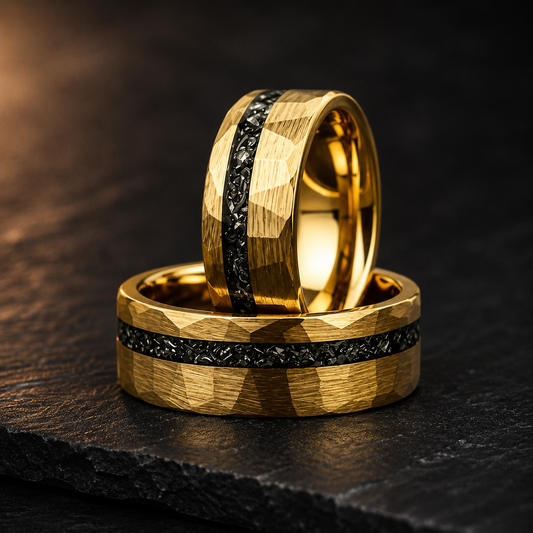
For men who appreciate organic surface texture and visual complexity, our hammered tungsten rings share the meteorite ring's instinct for surfaces that are alive rather than uniform. Where meteorite's pattern was created by physics over billions of years, hammered texture is created by craft over a single forging session. Both result in rings that look different at every angle, in every light — because they are.
Caring for Your Meteorite Ring
Keep it dry when possible. While the meteorite inlay in our rings is treated and protected within the tungsten setting, prolonged exposure to water — swimming, extended dishwashing, hot tubs — is worth minimizing. Brief contact with water during handwashing or light rain is not a concern. Extended submersion over time is.
Avoid harsh chemicals. Bleach, strong cleaning agents, and chlorinated water can affect the meteorite inlay over time. Remove your ring before working with these substances. This applies to virtually all rings regardless of material — meteorite is simply worth being deliberate about.
If surface oxidation appears. Despite protection, some meteorite rings may develop minor surface oxidation over years of wear in humid conditions. This can typically be addressed with a jeweler's touch-up. Contact us if you have concerns — we stand behind every ring in this collection.
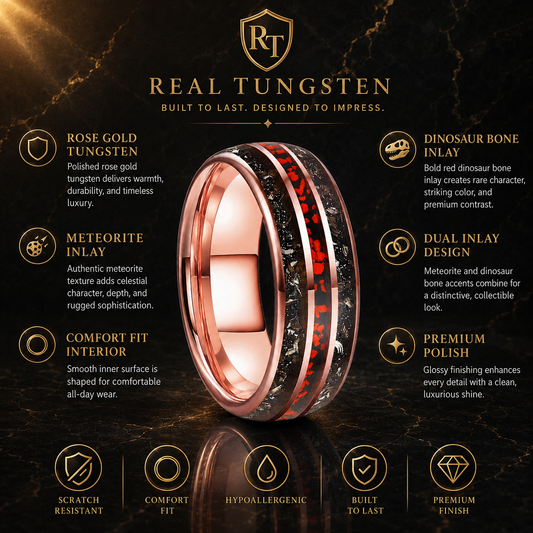
Comfort fit interior. Every ring in this collection features a comfort fit interior — the inside of the band is slightly domed rather than flat. This makes the ring comfortable for all-day wear from the first moment you put it on, distributing pressure evenly across the finger regardless of width.
Sizing. Tungsten cannot be resized after purchase. Get your size right before ordering — if you're between sizes, go up. For the most accurate result, visit a local jeweler for a professional sizing. A ring this significant deserves a fit that's exactly right.
Emergency removal. Tungsten rings can be safely removed by emergency personnel using vice grip tools that crack the band cleanly. This is standard procedure and applies to all tungsten rings regardless of inlay material. Your safety is fully protected.
The Wedding Band Beyond Compare
A meteorite wedding band is not a ring. It is a statement about what you value, what you find extraordinary, and what kind of man chooses to mark the most significant commitment of his life with a piece of material older than the Earth itself. If that resonates with you, explore our full tungsten wedding rings collection — every style built for the commitment that lasts, including the most extraordinary material any of them carries.
Not sure where to start? Our best sellers collection shows you what men keep coming back to across every style and finish. The meteorite rings are there — because men who find them rarely settle for anything less.
Four billion years in the making. Built to last a lifetime.
That's meteorite. That's this collection.